

- Security analysts monitor traffic, triage SIEM alerts, read logs and write incident reports, often inside a Security Operations Centre.
- Job Bank files security analyst jobs under cybersecurity specialists (NOC 21220), a group that usually asks for a university degree.
- Alberta medians: $30.00 an hour for IT support (NOC 22221) and $50.51 for cybersecurity specialists. The $50.51 is a Statistics Canada model estimate for the whole occupation, not entry pay.
- Typical entry points are Tier 1 SOC analyst roles, IT security support and junior information security roles.
- Employers list SIEM tools, log analysis, networking basics, scripting and clear report writing.
What a security analyst does day to day
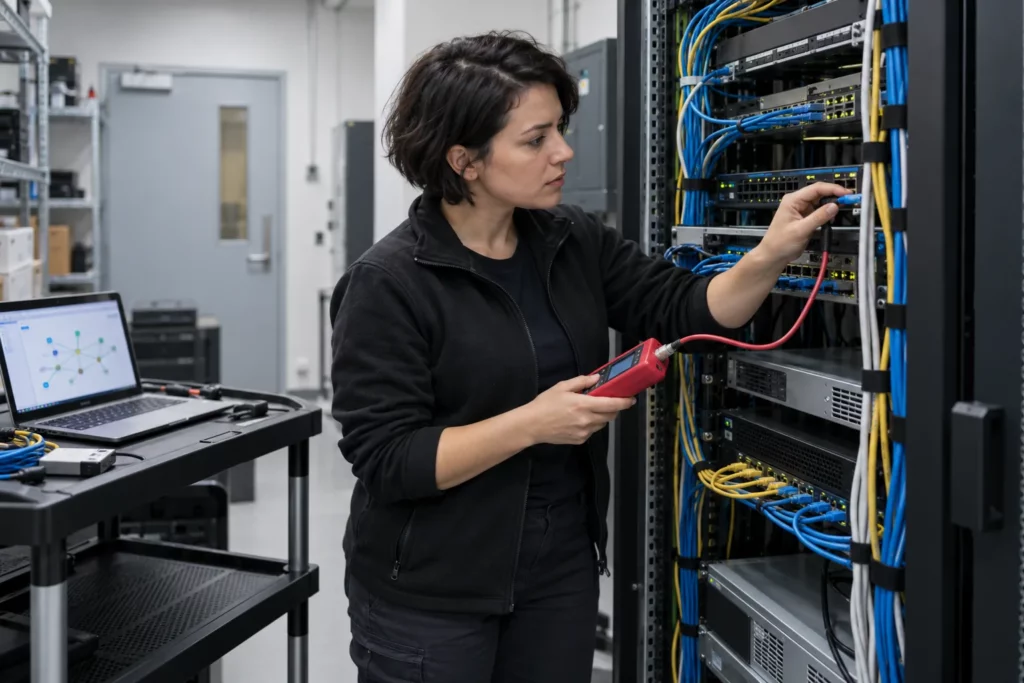
A security analyst is the first line of defence for an organization’s digital infrastructure. On a typical day, the role involves monitoring network traffic for suspicious patterns, triaging security alerts from a SIEM (Security Information and Event Management) platform, analysing system logs, and writing up incident reports. In larger organizations, security analysts work inside a Security Operations Centre (SOC) — a dedicated team that watches for threats around the clock.
Core responsibilities include:
- Continuous monitoring of endpoints, servers, and network traffic
- Threat detection and triage using SIEM tools such as Splunk, Microsoft Sentinel, or IBM QRadar
- Incident response — containing and documenting breaches or intrusion attempts
- Vulnerability scanning and prioritizing patches with IT teams
- Writing clear, accurate security reports for management
The role sits at the intersection of technical skill and clear communication. You need to translate a wall of log data into plain language that a non-technical manager can act on.
Security analyst vs cybersecurity specialist: how the depth differs
These titles are often used interchangeably by recruiters, but they represent different levels of depth. A security analyst typically operates at a monitoring and detection layer — watching, responding, and reporting. A cybersecurity specialist or engineer tends to go deeper: designing security architectures, conducting penetration testing, developing security policies from scratch, or managing cloud security posture at scale.
If you are just entering the field, the analyst path is the more accessible starting point. It gives you hands-on experience with real alerts and real incidents before you specialize. From the analyst role, you can branch into penetration testing, threat intelligence, cloud security, or governance and compliance — wherever your interests take you.
For a closer comparison of the two titles, see cybersecurity specialist vs security analyst.
Ucademy offers two programs that reflect this progression: a focused Security Analyst Certificate for those building foundational skills, and a broader Cybersecurity Specialist Diploma for learners who want to go further across the discipline.
Technical Skills Employers Look For
Entry-level postings in Canada typically list some combination of the following:
- SIEM platforms — hands-on experience querying logs and building alert rules
- Log analysis — reading Windows Event Logs, Linux syslog, firewall logs
- Networking fundamentals — TCP/IP, DNS, HTTP/S, how traffic flows and what anomalies look like
- Scripting basics — even a working knowledge of Python or PowerShell for automating repetitive checks
- Report writing — documenting findings clearly and concisely
- Frameworks — familiarity with NIST, MITRE ATT&CK, or CIS Controls is a plus at the junior level
Soft skills matter just as much. Attention to detail, calm under pressure, and the ability to explain technical findings to a non-technical audience are consistently mentioned in Canadian job postings.
The Entry-Level Path in Canada
Job Bank rates the 2025–2027 Alberta outlook for cybersecurity specialists as Moderate, and security analyst jobs are filed under that group (NOC 21220). Energy-sector employers in Alberta also hire for operational technology (OT) security, a distinct specialization.
Typical entry points include:
- Tier 1 SOC Analyst roles at managed security service providers (MSSPs)
- IT security support positions at mid-sized organizations
- Junior information security roles in financial services or healthcare
For current wage data in Alberta, see the Job Bank (Government of Canada). Wages vary by region, employer size, and experience level.
From IT support to security analyst: the numbers for Alberta
Official data about the occupations on the route to a security analyst role. It describes these jobs across the province, not what Ucademy students will earn, and it shows the less favourable figures as well as the favourable ones.
| IT support | Network technician | Cybersecurity specialist | |
|---|---|---|---|
| Job Bank group | User support technicians (22221) | Computer network and web technicians (22220) | Cybersecurity specialists (21220) |
| Alberta median wage | $30.00/hr | $38.67/hr | $50.51/hr* |
| Low to high | $20.19–$57.69 | $21.00–$55.00 | $35.40–$87.09* |
| Outlook 2025–2027, Alberta | Moderate | Moderate | Moderate |
| Job Bank “usually requires” | College diploma | College diploma | University degree |
| Workers with a college certificate or diploma | 33% | 39% | 32% |
| Workers with a bachelor’s degree or higher | 36% | 32% | 54% |
* Statistics Canada model estimate for 2024, not a survey result. Security analyst jobs are filed by Job Bank under cybersecurity specialists (21220), a group that usually asks for a degree. These figures describe whole occupations, not entry-level pay.
Source: Job Bank wages, outlooks and summaries · wages updated Nov 19, 2025; survey rows 2023–2024, estimate rows 2024; outlook updated Dec 10, 2025.
View the data as a table
| Occupation | Average offered hourly wage | Data quality (Statistics Canada letter) |
|---|---|---|
| IT support (user support) technician | $26.40 | quality A |
| Computer network technician | $35.30 | quality A |
| Cybersecurity specialist | $46.55 | quality A |
| All occupations | $27.45 | quality A |
These are average wages offered in job postings that employers had open, for all experience levels. They are not median pay of people already working, so they differ from Job Bank. The cybersecurity figure averages postings at all experience levels, so it is not a starting wage.
Source: Statistics Canada, job vacancies and average offered hourly wage, table 14-10-0444-01 · Alberta, second quarter 2026 (April–June).
Data checked October 19, 2026: Job Bank wages updated Nov 19, 2025, outlooks Dec 10, 2025; Statistics Canada job vacancies Q2 2026. Occupation data, not a program outcome.

Formal training or self-study: how they compare
Both paths have produced working security analysts. Self-study routes — using online practice labs, earning vendor certifications like CompTIA Security+, and building a home lab — are legitimate. But self-study requires strong self-discipline, a clear study plan, and the initiative to seek out mentors and communities on your own.
A structured certificate program offers a different set of advantages: a defined curriculum mapped to employer expectations, instructor guidance when you get stuck, and a credential that signals to Canadian employers that you have covered the required ground. For career changers or those without a technical background, structure can shorten the learning curve.
| Self-study | Structured program | |
|---|---|---|
| What it takes | Strong self-discipline, a clear study plan and a home lab | A defined curriculum mapped to employer expectations |
| Help when you are stuck | You find mentors and communities on your own | Instructor guidance |
| Credential | Vendor certifications such as CompTIA Security+ (an exam) | A credential that shows you covered the required ground |
| Often a good fit for | People who are comfortable planning and studying alone | Career changers and people without a technical background |
Neither path excludes the other. Many successful analysts combine a formal program with ongoing personal labs and community involvement.
If you go the certification route, cybersecurity certifications explained shows where to start in Alberta.
Comparing the two Ucademy security programs
If you are considering a career in security analysis, start by exploring the programs available to you, understanding what skills each covers, and mapping that against the types of roles you want to apply for. Ucademy’s Security Analyst Certificate and Cybersecurity Specialist Diploma are both delivered online and designed to fit around work and family commitments. Reach out to the admissions team to discuss your background, your goals, and which program is the right fit before you enrol.
Sources
- Job Bank: employment outlook for cybersecurity specialists in Alberta (NOC 21220)
- Statistics Canada: job vacancies and average offered hourly wage, table 14-10-0444-01
- Job Bank (Government of Canada)
Related reading: What Does a Cybersecurity Analyst Do? Role, Skills & Salary in Alberta
Frequently Asked Questions
What does a security analyst do in Canada?
Security analysts monitor an organization's networks and systems for threats, investigate alerts, respond to incidents, and help implement security controls. They act as the first line of defense against cyberattacks and data breaches.
Do I need a university degree to become a security analyst in Canada?
A degree is not always required. Many Canadian employers in cybersecurity hire candidates who hold relevant diplomas or certificates and can demonstrate practical skills through labs, projects, or recognized certifications such as CompTIA Security+.
What technical skills should an aspiring security analyst build first?
Core skills include understanding networking fundamentals (TCP/IP, DNS, firewalls), operating systems (Windows and Linux), basic scripting, and security concepts like threat modelling and vulnerability assessment. Hands-on lab practice with these areas is essential for job readiness.
Is cybersecurity a growing field in Canada?
Cybersecurity is widely regarded as one of the fastest-growing technology fields in Canada. Organizations across sectors — government, finance, healthcare, and retail — continue to expand their security teams as digital threats increase in frequency and complexity.