

By the Ucademy Team
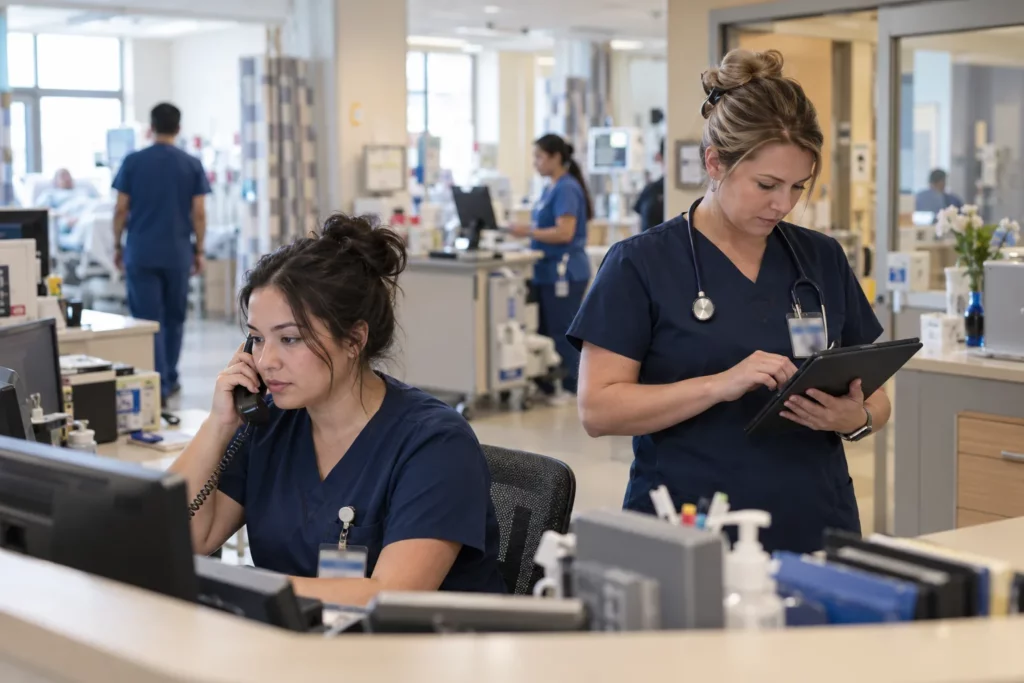
Behind every busy hospital unit is a person keeping the paperwork, the phones and the physician orders moving: the unit clerk. Also called a ward clerk, health unit clerk or health unit coordinator, a unit clerk is the administrative anchor of a nursing unit. It is a way to work in healthcare without clinical training, and in Alberta it is a role many people move into from office or customer service work.
This guide covers what unit clerks do, the skills employers look for, how training works, and what Government of Canada Job Bank data actually says about pay and outlook in Alberta.
The short version
- What: administrative coordination on a hospital or care-facility unit: charts, physician orders, admissions and discharges, phones and visitors.
- Where: mainly hospitals, plus continuing care, surgical centres and other inpatient settings.
- Training: no provincial licence is required to work as a unit clerk, but employers usually look for completed training in medical terminology and health administration.
- Pay: Job Bank lists unit clerks under NOC 14100 (General office support workers), with Alberta wages of $15.50 to $36.13 an hour and a median of $25.00.
- Outlook: Job Bank rates this group Limited in Alberta for 2025–2027, so plan for a competitive search.

What a unit clerk does
A unit clerk keeps a nursing unit organized so nurses and physicians can focus on patients. Typical duties include:
- Processing physician orders: entering or transcribing orders accurately into the clinical information system and making sure the right department receives them.
- Managing patient records: assembling, updating and filing charts and electronic health records.
- Admissions, transfers and discharges: preparing paperwork and coordinating with admitting, porters and other units.
- Booking tests and procedures: scheduling diagnostic imaging, lab work and consultations for patients on the unit.
- Being the communication hub: answering phones and call bells, greeting visitors, paging staff and relaying messages.
- Supplies and forms: keeping the unit stocked with forms and supplies and placing requisitions.
The work is busy, and interruptions are constant. Good unit clerks stay calm, prioritize quickly and double-check anything that affects patient care.
Unit clerk vs. medical office assistant
Both are administrative healthcare roles, but the setting differs. A unit clerk supports a clinical team inside a hospital or care facility, often on rotating shifts. A medical office assistant works at the front desk of a clinic or specialist office, usually during business hours, and deals more with patients and billing. For a detailed comparison, read Medical Office Assistant vs Unit Clerk.
| Unit clerk | Medical office assistant | |
|---|---|---|
| Where | Hospital or care-facility unit | Front desk of a clinic or specialist office |
| Hours | Often rotating shifts, including evenings, nights and weekends | Usually business hours |
| Main work | Physician orders, charts, admissions and discharges, phones and call bells | Booking, check-in, billing and patient contact |
| Job Bank group | General office support workers (NOC 14100) | Medical administrative assistants (NOC 13112) |
| Alberta median wage | $25.00 an hour | $29.00 an hour |
| Alberta outlook 2025–2027 | Limited | Good |
NOC 14100 is a broad office-support group, not only hospital units, so the pay comparison is approximate. Wages depend on the employer, shifts and experience and are not guaranteed. Source: Job Bank, unit clerk and Job Bank, medical administrative assistant (Alberta).
Where unit clerks work in Alberta
- acute care hospitals: emergency, surgery, medicine, maternity, intensive care and other units;
- continuing care and long-term care facilities;
- surgical centres and other facilities with inpatient or day-procedure units;
- mental health and rehabilitation facilities.
Hospitals run around the clock, so many positions include evenings, nights, weekends or casual shifts, especially at the start. Many Alberta hospitals use Connect Care, the province’s shared clinical information system, so experience with electronic health records is useful.
Skills employers look for
- Medical terminology: reading and transcribing clinical language accurately.
- Computer and keyboarding skills: fast, accurate data entry and comfort with electronic health records.
- Attention to detail: one wrong digit in an order can matter.
- Communication: clear, professional contact with nurses, physicians, patients and families, sometimes in stressful moments.
- Multitasking under pressure: handling the phone, a visitor and an urgent order at the same time.
- Privacy and confidentiality: in Alberta, health information is governed by the Health Information Act, and unit clerks handle sensitive records every day.
How to become a unit clerk in Alberta, step by step
- Check the basics. Most training programs and employers expect a high school diploma or equivalent, strong English and solid computer skills.
- Complete training. Look for a program that covers medical terminology, health records and electronic health records, order processing, medical office procedures and privacy. Unit clerk and health unit coordinator programs are offered by public colleges and licensed private career colleges, usually at the certificate level.
- Get practical experience. A supervised practicum in a healthcare setting gives you real experience and a reference. Ask whether a program includes one and how placements are arranged — see how practicums work at Ucademy.
- Build your keyboarding speed and accuracy. Some employers test data-entry or typing skills as part of hiring.
- Apply widely and be flexible. Casual and part-time postings, and positions outside the biggest cities, are common ways in. Check job postings for exactly what each employer requires.
Before you choose a private program, check that it is licensed. Our guide How to Check if a Career College Is Licensed in Alberta walks you through the official registry.
Unit clerk salary and outlook in Alberta
Job Bank groups unit clerks under NOC 14100 General office support workers. For Alberta, reference period 2023–2024:
| Low | Median | High |
|---|---|---|
| $15.50/hr | $25.00/hr | $36.13/hr |
Job Bank rates the employment outlook for this group as Limited in Alberta for 2025–2027. It expects employment to stay relatively stable, with openings coming mostly from retirements, while automation and new software reduce the number of general office roles. Keep in mind that this group covers many kinds of office support work, not only hospital units.
Source: Job Bank, Unit Clerk in Alberta. Wages depend on the employer, collective agreements, shifts and experience, and are not guaranteed.
For comparison, Job Bank rates medical administrative assistants (NOC 13112) as Good in Alberta for the same period. Training that covers both clinic and hospital administration can widen the range of jobs you can apply for. Try our Alberta salary calculator to compare occupations.
The numbers behind unit clerk pay and demand in Alberta
Official data about unit clerks, using the closest Job Bank group (general office support workers, NOC 14100) and hospital job postings. It describes this work across Alberta — not what Ucademy students will earn — and it shows the less favourable figures as well as the good ones.
Source: Job Bank (NOC 14100) and Alberta Wage and Salary Survey 2023 (alis) · outlook updated Dec 10, 2025; employer survey 2023.
| Posted | Position | Hourly range (link to posting) | Union | Requirements shown |
|---|---|---|---|---|
| Mar–May 2026 (posted May 21, 2026) | Manning (North Zone), casual/relief | $27.66–$33.61 | AUPE General Support Services | Grade 12 or equivalent + accredited unit clerk course or equivalent; Connect Care knowledge |
| July 2025 (posted July 12, 2025) | Fort McMurray, casual/relief | $26.07–$31.68 | AUPE General Support Services | Grade 12 or equivalent + accredited unit clerk course or equivalent |
| 2018 (posted July 6, 2018) | University of Alberta Hospital, regular part-time | $24.99–$30.38 | AUPE General Support Services | Grade 12 or equivalent + accredited unit clerk course or equivalent |
These are examples of posted pay for individual casual or part-time positions — not an AHS pay scale, and not a promise of what a new unit clerk will be offered. Older postings also asked for a computer knowledge test and basic life support. Postings change; check current openings on the AHS careers site.
Source: Alberta Health Services career postings · three postings, 2018–2026; the 2026 posting has since closed.
View the data as a table
| Group | 5th percentile | Average | 95th percentile | Data |
|---|---|---|---|---|
| Health care — starting | $20.00/hr | $24.69/hr | $25.56/hr | Alberta Wage and Salary Survey 2023 |
| Health care — overall | $23.54/hr | $28.54/hr | $29.79/hr | Alberta Wage and Salary Survey 2023 |
| Health care — top | $27.21/hr | $30.42/hr | $31.06/hr | Alberta Wage and Salary Survey 2023 |
| All industries — starting | $15.90/hr | $23.46/hr | $30.30/hr | Alberta Wage and Salary Survey 2023 |
| All industries — overall | $19.39/hr | $27.24/hr | $34.97/hr | Alberta Wage and Salary Survey 2023 |
| All industries — top | $21.50/hr | $31.25/hr | $47.60/hr | Alberta Wage and Salary Survey 2023 |
Bars show the 5th to 95th percentile of hourly pay and the dot is the average. In health care and social assistance the average salary as paid is $48,368 a year. “Starting” is the average pay employers offered for entry-level positions with this title — not what any program’s graduates earn. The survey excludes overtime, bonuses and benefits.
Source: Alberta Wage and Salary Survey 2023 (alis), NOC 14100 · employer survey, 2023; health care reliability B (good), all industries A (high).
View the data as a table
| Area | Low | Median | High | Data |
|---|---|---|---|---|
| Alberta | $15.50/hr | $25.00/hr | $36.13/hr | Labour Force Survey, 2023–2024 |
| Calgary | $18.00/hr | $25.38/hr | $36.06/hr | Labour Force Survey, 2023–2024 |
| Edmonton † | $15.50/hr | $25.00/hr | $36.13/hr | Labour Force Survey, 2023–2024 |
| Red Deer † | $15.50/hr | $25.00/hr | $36.13/hr | Labour Force Survey, 2023–2024 |
| Athabasca–Grande Prairie | $15.00/hr | $26.00/hr | $33.18/hr | Labour Force Survey, 2023–2024 |
| Lethbridge–Medicine Hat † | $15.50/hr | $25.00/hr | $36.13/hr | Labour Force Survey, 2023–2024 |
| Banff–Jasper | $15.00/hr | $26.00/hr | $33.18/hr | Labour Force Survey, 2023–2024 |
| Camrose–Drumheller | $19.00/hr | $26.00/hr | $33.85/hr | Labour Force Survey, 2023–2024 |
| Wood Buffalo–Cold Lake † | $15.50/hr | $25.00/hr | $36.13/hr | Labour Force Survey, 2023–2024 |
| Canada | $16.55/hr | $23.99/hr | $34.00/hr | Labour Force Survey, 2023–2024 |
Job Bank “low” and “high” are roughly the bottom and top 10% of earners. † Same figures as the Alberta row; Job Bank appears to repeat the provincial figure where a regional sample is small, so this is not a separate regional finding. NOC 14100 is a broad group of office-support jobs, not only hospital unit clerks — only 23% of its workers are in hospitals — so its range includes office jobs outside hospitals. Wages depend on the employer, experience and location and are not guaranteed.
Source: Job Bank, wages for unit clerks (NOC 14100) · wages updated Nov 19, 2025; survey rows 2023–2024.
- Hospitals 23%
- Construction 8%
- Ambulatory health care 5%
- Other retail 5%
- All other sectors 59%
This is why the hospital-specific figures above (AHS postings and the health-care survey rows) are the closer guide to hospital unit clerk pay.
Source: Job Bank, workers by industry (NOC 14100) · Alberta.
Data checked October 19, 2026: Job Bank wages updated Nov 19, 2025, outlooks Dec 10, 2025; Alberta Wage and Salary Survey 2023. Occupation data, not a program outcome. AHS postings as listed.
Taking a unit clerk course online: what to check
Unit clerk training goes by several names — hospital unit clerk, ward clerk, health unit clerk or health unit coordinator — and it is often combined with medical office assistant training. If you are comparing online courses, these questions help:
- Is the school licensed? Private career colleges in Alberta must be licensed to offer vocational programs. Check the official registry before you pay anything.
- Does it cover hospital work, not only clinics? Look for medical terminology, processing physician orders, patient charts, electronic health records and privacy under Alberta’s Health Information Act.
- Do you practise on real software? Hands-on practice with an electronic health record system matters more than reading about one.
- Is there a supervised practicum? Ask how many hours, what kinds of workplaces, how placements are arranged and what hosts usually require before you start, such as a police information check or immunizations.
- How long will it really take? Ask for total program hours and a realistic part-time timeline, not just “weeks”.
- What does it cost in total? Include books, software, exam fees and any checks a practicum host may ask for.
- Who helps you? Find out how you reach instructors, how quickly they answer and what career support you get at the end.
Before you start, the free online learning readiness check shows how your typing and computer skills measure up, and the funding finder lists ways to pay that may fit your situation.
A quick self-check
- Do you like a fast pace with constant interruptions?
- Are you comfortable with shift work, including evenings, nights or weekends?
- Are you precise with data entry, even under pressure?
- Do you want to work in healthcare without hands-on patient care?
- Can you stay calm and kind when patients and families are stressed?
Mostly yes? Unit clerk work may suit you. Prefer regular hours and more patient contact? Look at how to become a medical office assistant in Alberta.
How Ucademy’s program fits
Ucademy’s Medical Office Assistant & Unit Clerk Certificate is designed to prepare you for both clinic and hospital administration in one program: 516 hours across 12 courses, including medical terminology, the Canadian healthcare system, electronic health records with SimChart EHR, medical office procedures and privacy, a course on the fundamentals of unit clerk operations, medical billing and coding, and a 100-hour supervised practicum. Coursework is online and self-paced; as a guide, part-time study of 12–15 hours a week takes about nine months.
Request information to learn more about the program.
Sources
- Job Bank: unit clerk in Alberta, summary (NOC 14100)
- Job Bank: unit clerk in Alberta, job prospects and workers by industry
- Job Bank: unit clerk in Alberta, wages
- Job Bank: medical administrative assistant in Alberta, wages (NOC 13112)
- Alberta Wage and Salary Survey 2023 (alis): general office support workers, NOC 14100
- Alberta Health Services careers: unit clerk postings
- Government of Alberta: Health Information Act
- Alberta Health Services: Connect Care
Wage figures are labour-market data for guidance only, not a promise of earnings. Checked October 2026.
Frequently Asked Questions
What does a unit clerk do in Alberta?
A unit clerk, also called a ward clerk or health unit coordinator, handles the administrative work of a hospital or care-facility unit: processing physician orders, maintaining charts, coordinating admissions, transfers and discharges, booking tests and acting as the unit's communication hub.
Do I need a licence to work as a unit clerk in Alberta?
No provincial licence is required to work as a unit clerk. Employers usually look for completed training in medical terminology, health records and medical office procedures, strong computer skills and, ideally, practicum experience.
How much do unit clerks earn in Alberta?
Job Bank lists unit clerks under NOC 14100 General office support workers, with Alberta hourly wages of $15.50 low, $25.00 median and $36.13 high for 2023 to 2024. Pay depends on the employer, shifts and experience and is not guaranteed.
Are unit clerk jobs in demand in Alberta?
Job Bank rates the outlook for NOC 14100 General office support workers as Limited in Alberta for 2025 to 2027, with openings mostly from retirements. The group covers many kinds of office work, so check current hospital postings in your area.
How is a unit clerk different from a medical office assistant?
A unit clerk supports a clinical team inside a hospital or care facility, often on rotating shifts. A medical office assistant works at the front desk of a clinic or specialist office, usually during business hours, with more patient contact and billing.
Train for this career
Ucademy's online Medical Office Assistant and Unit Clerk Certificate is designed to help you build the skills employers look for.