
By the Ucademy Team
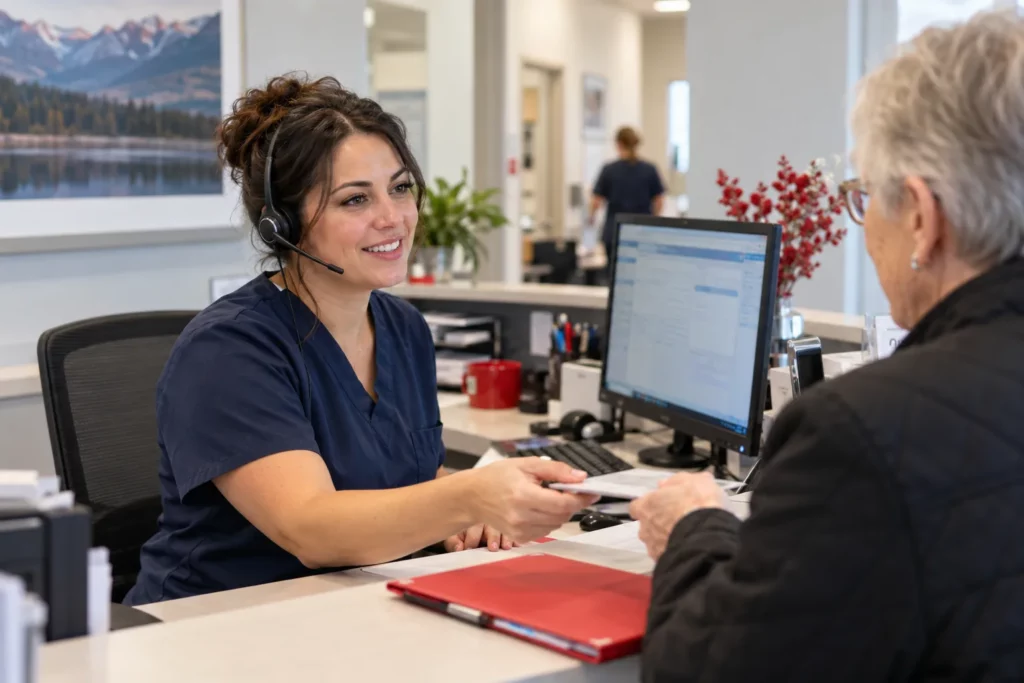
Alberta’s clinics — family practices, walk-in clinics, specialist offices, dental and allied health practices — all run on the same thing: someone at the front desk who keeps patients moving, billing accurate, and the office organized. That’s the Medical Office Assistant (MOA). This guide covers what the job involves, the four steps into it in Alberta, and what Job Bank’s numbers say about pay and demand.
- The job: front-desk and records work in a medical office: scheduling, Alberta Health Care billing, referrals and electronic medical records. No clinical training is required.
- Pay and demand (Job Bank, Alberta): medical administrative assistants (NOC 13112) have a median wage of $29.00 an hour and a Good outlook for 2025–2027. The receptionist profile that Job Bank titles “Medical Office Assistant” (NOC 14101) has a median of $21.00 and a Moderate outlook.
- Entry route: for 13112, Job Bank lists a college diploma, a short apprenticeship, or more than six months of on-the-job training. It lists the job as not regulated in Canada.
- Four steps: learn what clinics screen for, train in terminology, EMR software and Alberta billing, build practice with real documents, then apply to clinics directly as well as on job boards.
- Read the numbers as a range: these are occupation figures for Alberta, not what any program’s students will earn.
What a Medical Office Assistant actually does
An MOA is the administrative backbone of a medical office. Typical responsibilities include:
- Greeting and checking in patients, and managing the flow of a busy waiting room
- Scheduling, rescheduling, and confirming appointments
- Verifying Alberta Health Care coverage and handling billing, including provincial billing codes
- Managing referrals, faxes, and correspondence between the clinic, specialists, labs, and pharmacies
- Maintaining electronic medical records (EMR) accurately and confidentially
- General office duties — supply ordering, basic bookkeeping, opening and closing procedures
It’s a role that blends customer service, administrative precision, and enough medical knowledge to understand what’s being scheduled, billed, and filed — without requiring clinical training.

Step 1: Understand what employers actually look for
Alberta clinics hiring MOAs are generally looking for familiarity with medical terminology, comfort with EMR software (systems like Wolf, Med Access, or Accuro are common in Alberta), knowledge of Alberta Health Care billing procedures, and solid communication skills for dealing with patients who may be anxious, in pain, or frustrated. Because MOAs handle sensitive health information, employers also expect a working understanding of privacy requirements under Alberta’s Health Information Act.
According to Job Bank, this occupation (NOC 13112, Medical Administrative Assistants) usually requires a college diploma, an apprenticeship of less than two years, or more than six months of on-the-job training. In practice, most employers in Alberta prefer candidates who’ve completed a formal MOA program over those relying purely on general office experience, simply because the medical terminology and billing knowledge take real time to build from scratch on the job.
Certificate requirements for medical office assistants in Alberta
No provincial licence is needed to work as a medical office assistant. The Government of Alberta’s alis career profile is clear on this point:
“There is currently no provincial legislation regulating this occupation in Alberta.”
In practice, employers set the bar. alis notes that medical and dental offices often ask for a diploma or certification from an MOA program, and Job Bank says a one- or two-year college program or other specialized courses for medical secretaries is usually required for medical administrative assistants.
| What the law requires | What employers commonly ask for | |
|---|---|---|
| Licence or registration | None for MOAs in Alberta | — |
| Training | Not set by law | A diploma or certificate from an MOA program |
| Typing | Not set by law | At least 50 words a minute, preferably 60, with no more than 3 errors (alis) |
| Knowledge | Not set by law | Medical terminology, records, privacy and billing |
A quick way to check where you stand is the typing test in the free online learning readiness check. For the training itself, compare program hours, course lists and whether a supervised practicum is included.
Step 2: Get trained
A focused MOA training program is the fastest way to build the specific skill set clinics are hiring for — medical terminology, EMR software, scheduling systems, and Alberta Health Care billing — without spending years in general post-secondary education. This is exactly the gap Ucademy’s Medical Office Assistant program is designed to close: a career-focused, online program built around what Alberta clinics actually ask for in job postings.
If you’re comparing training options, look for a program that covers medical terminology and anatomy basics, practical EMR/scheduling software training, Alberta-specific billing knowledge, and some form of practical or applied component — not just theory. Ask directly how the program prepares you for the administrative and billing side of real clinic work, since that’s where most new MOAs feel the steepest learning curve in their first weeks on the job.
Step 3: Build your practical skills and document handling
You can build these through a program’s practicum component or on your own. Before you start job hunting, work on a few things deliberately: typing speed and accuracy, at least one major EMR platform, basic medical terminology (enough to read a referral or a chart note without stumbling), and Alberta Health Care billing basics. Employers notice candidates who can speak to these specifically in an interview rather than only listing “administrative experience.”
| Skill | Why clinics ask for it | How to show it on a resume |
|---|---|---|
| Medical terminology | MOAs read referrals, chart notes and lab requisitions all day | List the terminology coursework; use the correct terms in interview answers |
| EMR software | Appointments, notes and billing sit in one system; Wolf, Med Access and Accuro are common in Alberta | Name the systems you trained on and one task you did in each |
| Alberta Health Care billing | Billing runs on provincial codes, so accuracy matters | Say which steps you practised, such as coverage checks and claim entry |
| Privacy | Health information falls under Alberta’s Health Information Act | Mention privacy training and how you verify identity at the desk |
| Patient communication | Patients may be anxious, in pain or frustrated | Give one short example of calming a difficult conversation; customer service counts |
| Typing speed and accuracy | Records and billing need clean entries | Report a measured words-per-minute score |
Based on the skills listed in this guide, not on a Job Bank requirement.
Step 4: Apply strategically
MOA openings in Alberta show up on Job Bank, clinic and health authority career pages, and general job boards — but many smaller clinics hire through word of mouth or by posting only on their own website. It’s worth directly checking the career pages of clinics you’re interested in, not just the big aggregators. A tailored resume that highlights medical terminology, EMR familiarity, and billing knowledge — even from a training program rather than paid work experience — tends to stand out in a stack of generic office-administration resumes.
What the data says about pay and demand
Based on the most recent Job Bank figures for Medical Administrative Assistants (NOC 13112) in Alberta:
- Median wage: $29.00/hour.
- Employment outlook, 2025–2027: rated Good by Job Bank, based on moderate growth in new positions, a moderate number of retirements creating openings, and a comparatively small pool of unemployed workers with recent experience in the occupation.
- Sector context: Job Bank notes that Alberta’s Budget 2025 allocates $28 billion to health services — a 5.4% increase from the prior year — which it cites as a relevant factor for demand in healthcare administrative roles, alongside Alberta’s aging population.
These are provincial averages and projections, not a guarantee of what any individual will earn or how quickly they’ll find work — actual pay and hiring speed depend on your location, the specific clinic, and your experience. Directionally, Job Bank documents real demand for the role in Alberta.
The numbers behind the medical office assistant wage
Official data about medical office assistants, using the two Job Bank profiles people find under that title. It describes these jobs across Alberta — not what Ucademy students will earn — and it shows the less favourable figures as well as the good ones.
| Medical administrative assistant | Job Bank “Medical Office Assistant” | |
|---|---|---|
| Job Bank profile | Medical administrative assistants (NOC 13112) | Receptionists (NOC 14101) — the profile Job Bank titles “Medical Office Assistant” |
| Alberta median wage | $29.00/hr | $21.00/hr |
| Alberta range, low to high | $20.00–$35.00/hr | $16.75–$30.00/hr |
| Canada median wage | $25.00/hr | $21.00/hr |
| Alberta outlook 2025–2027 | Good | Moderate |
| Employed in Alberta | ~9,150 | ~20,400 |
| Work full-time | 78% | 67% |
| Usual entry requirement (Job Bank) | College diploma, apprenticeship of less than 2 years, or more than 6 months of on-the-job training | High school diploma or several weeks of on-the-job training |
| Where they work | Ambulatory health care 61%, hospitals 28% | Ambulatory health care 35%, hospitals 8%, other retail 7%, personal and laundry services 6% |
| Employers that recruited in the last 2 years (survey, 2023) | 61% | 49% |
| …of those, had trouble hiring | 34% | 28% |
| At least one non-wage benefit | 63.9% (Canada: 79.8%) | 68.4% (Canada: 66.3%) |
Employers use these job titles differently, so we show both neighbouring Job Bank groups. Job Bank lists medical administrative assistants (13112) as not regulated in Canada, so no licence or exam is required to work in the job.
Source: Job Bank wages and outlooks; Alberta Wage and Salary Survey 2023 (alis) · wages updated Nov 19, 2025; survey rows 2023–2024; outlook updated Dec 10, 2025.
View the data as a table
| Profile and area | Low | Median | High | Data |
|---|---|---|---|---|
| 13112 · Alberta | $20.00/hr | $29.00/hr | $35.00/hr | Labour Force Survey, 2023–2024 |
| 13112 · Calgary | $20.00/hr | $30.28/hr | $35.00/hr | Labour Force Survey, 2023–2024 |
| 13112 · Edmonton | $22.00/hr | $29.00/hr | $35.90/hr | Labour Force Survey, 2023–2024 |
| 13112 · Canada | $18.92/hr | $25.00/hr | $32.00/hr | Labour Force Survey, 2023–2024 |
| 14101 · Alberta | $16.75/hr | $21.00/hr | $30.00/hr | Labour Force Survey, 2023–2024 |
| 14101 · Calgary | $17.00/hr | $21.00/hr | $30.00/hr | Labour Force Survey, 2023–2024 |
| 14101 · Edmonton | $16.00/hr | $20.00/hr | $27.76/hr | Labour Force Survey, 2023–2024 |
| 14101 · Canada | $16.25/hr | $21.00/hr | $29.00/hr | Labour Force Survey, 2023–2024 |
Job Bank “low” and “high” are roughly the bottom and top 10% of earners. 13112 figures for every region are on the medical office assistant & unit clerk program page; 14101 regional figures are on Job Bank. Wages depend on the employer, experience and location and are not guaranteed.
Source: Job Bank, wages for medical administrative assistants (13112) and “Medical Office Assistant” (14101) · wages updated Nov 19, 2025; survey rows 2023–2024.
View the data as a table
| Group | 5th percentile | Average | 95th percentile | Data |
|---|---|---|---|---|
| 13112 · starting | — | $23.57/hr | — | Alberta Wage and Salary Survey 2023 |
| 13112 · overall | — | $27.55/hr | — | Alberta Wage and Salary Survey 2023 |
| 13112 · top | — | $29.99/hr | — | Alberta Wage and Salary Survey 2023 |
| 14101 · starting | $15.00/hr | $19.06/hr | $27.72/hr | Alberta Wage and Salary Survey 2023 |
| 14101 · overall | $16.00/hr | $21.94/hr | $31.25/hr | Alberta Wage and Salary Survey 2023 |
| 14101 · top | $18.00/hr | $26.24/hr | $37.00/hr | Alberta Wage and Salary Survey 2023 |
Bars show the 5th to 95th percentile and the dot is the average. For 13112 only the averages are shown: several of its survey cells repeat the same value, a sign of a small sample. Average salary as paid: $50,562 a year for 13112 and $38,316 for 14101. “Starting” is what employers offered for entry-level positions with the title — not what any program’s graduates earn.
Source: Alberta Wage and Salary Survey 2023 (alis), NOC 13112 and 14101 · employer survey, 2023; 13112 reliability B (good), 14101 A (high).
| Alberta | Athabasca–Grande Prairie | Banff–Jasper | Calgary | Camrose–Drumheller | Edmonton | Lethbridge–Medicine Hat | Red Deer | Wood Buffalo–Cold Lake | |
|---|---|---|---|---|---|---|---|---|---|
| Medical administrative assistant NOC 13112 |
Good | Very good | Very good | Good | Very good | Good | Very good | Very good | Very good |
| Receptionist / “Medical Office Assistant” NOC 14101 |
Moderate | Moderate | Moderate | Moderate | Moderate | Moderate | Moderate | Moderate | Moderate |
Job Bank also notes that advanced software and automation may lead to more complex tasks and fewer positions in the future for medical administrative assistants.
Source: Job Bank outlooks · outlook updated Dec 10, 2025.
Data checked October 19, 2026: Job Bank wages updated Nov 19, 2025, outlooks Dec 10, 2025; Alberta Wage and Salary Survey 2023. Occupation data, not a program outcome.
Who the medical office assistant role suits
The MOA role suits people who like structure, don’t mind a busy front desk, and want steady, patient-facing work without pursuing a clinical credential. If that sounds like a good match — or if you’re weighing it against a related option — read our companion article on how the Medical Office Assistant role compares to a Unit Clerk. The two are often confused but lead to different day-to-day work.

Related reading for the next step
- What Is an EMR? Electronic Medical Records in Alberta Clinics explains the software you will use every day.
- Medical Office Assistant Jobs in Alberta covers what the role pays and who hires.
- How to Become a Unit Clerk in Alberta is the hospital-side route.
Next step
You can review the full curriculum on the Medical Office Assistant program page, check common questions in the FAQ, or request information.
Sources
- Job Bank: wages for medical administrative assistants (NOC 13112), Alberta
- Job Bank: employment outlook for medical administrative assistants, Alberta
- alis: wages and salaries in Alberta, medical administrative assistants (13112)
Checked October 20, 2026.
Frequently Asked Questions
What does a Medical Office Assistant do in Alberta?
A Medical Office Assistant handles a range of administrative and clinical support tasks in healthcare settings such as physician offices, clinics, and hospitals. Responsibilities typically include scheduling appointments, managing patient records, processing billing and insurance forms, and greeting patients. The role is a critical link between clinical staff and the administrative operations of a medical practice.
What training is required to become an MOA in Alberta?
Most employers in Alberta prefer candidates who have completed a recognized Medical Office Assistant diploma or certificate program. These programs cover medical terminology, health records management, billing codes, and office software. Formal training helps candidates stand out in a competitive job market and ensures they are prepared for the specific demands of a healthcare office environment.
Is there demand for Medical Office Assistants in Alberta?
Healthcare administration roles, including Medical Office Assistants, are consistently in demand across Alberta due to the ongoing need for organized and efficient clinical support in medical facilities. Growth in population and an aging demographic contribute to sustained demand for administrative support in healthcare. Job seekers with relevant training and experience are generally well-positioned in this field.
Can I complete MOA training online in Alberta?
Yes, several institutions including Ucademy offer Medical Office Assistant training online, allowing students to study from home while balancing other commitments. Online programs typically cover the same core content as in-person options, including medical terminology, clinical procedures knowledge, and health records software. Students should confirm that the program meets the expectations of local employers before enrolling.
Train for this career
Ucademy's online Medical Office Assistant and Unit Clerk Certificate is designed to help you build the skills employers look for.