

By the Ucademy Team
Search for “medical office assistant course online” and you will find dozens of options with very different lengths and prices. Some are a few weeks of videos; others are full programs with a practicum. If you live in Alberta and want to work at a clinic front desk or in hospital administration, the differences matter.
This guide explains what a good medical office assistant (MOA) course should cover, how online study and practicums work, what Government of Canada Job Bank says about pay and outlook, and the questions to ask before you pay anyone.
The short version
- MOA work in Alberta is administrative: reception, scheduling, records, billing and privacy, not hands-on patient care.
- A solid program covers medical terminology, electronic health records, office procedures, billing and coding, privacy and communication, and ideally includes a supervised practicum.
- Coursework can be fully online; a practicum happens in a real workplace.
- In Alberta, a private college program that costs more than $1,000 must be licensed. Check before you sign. Job Bank puts Alberta median pay at $29.00 an hour for medical administrative assistants, with a Good outlook.
Medical office assistant vs. “medical assistant”
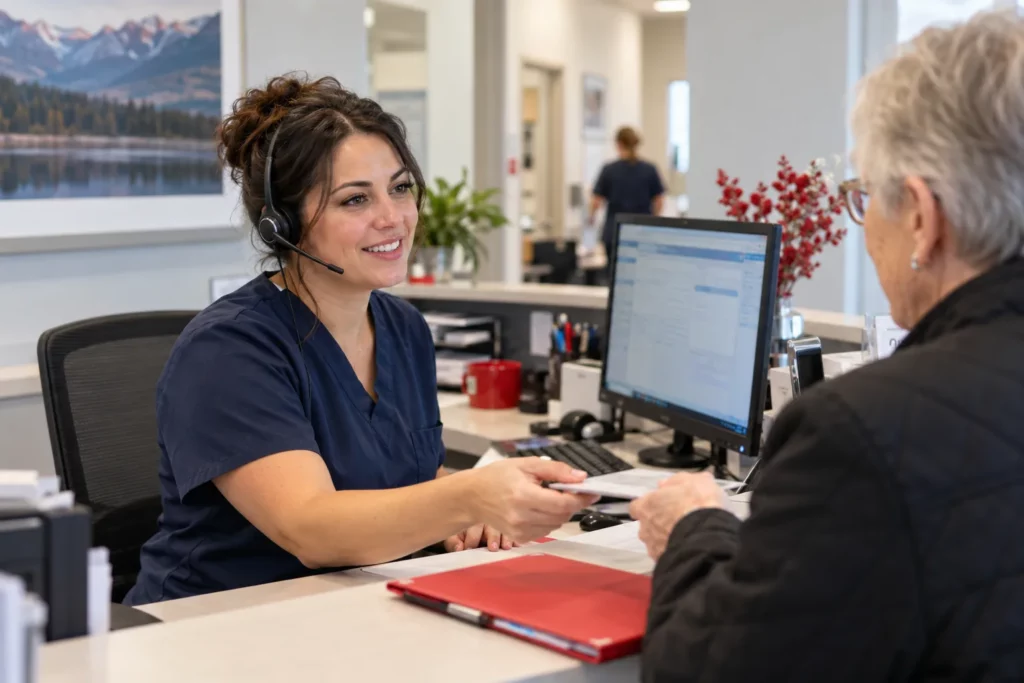
Many online courses use the US term “medical assistant”, which often includes clinical tasks such as taking vital signs. In Alberta, job postings for medical office assistants, medical administrative assistants and medical receptionists describe administrative work. If you want an office role in Canadian clinics, choose training built around Canadian healthcare administration rather than a US clinical curriculum.
What a good MOA course should cover
- Medical terminology and basic anatomy and physiology, so you can read and transcribe clinical language.
- The Canadian healthcare system, including how provincial health insurance works.
- Electronic health records (EHR) and scheduling software, ideally with hands-on practice in a simulated system.
- Medical office procedures: reception, appointment booking, referrals, records management.
- Billing and coding basics.
- Privacy and ethics: in Alberta, health information is governed by the Health Information Act.
- Communication with patients, families and clinical staff, including difficult conversations.
- A supervised practicum in a healthcare setting, which gives you real experience and a reference.
If you also want to be able to apply for hospital roles, look for content on unit clerk work: processing physician orders, admissions and discharges. See Medical Office Assistant vs Unit Clerk for how the two jobs differ.
Online study and the practicum
Theory works well online: recorded lessons, readings, quizzes and simulated EHR exercises can all be done from home, often at your own pace. The practicum is different. It takes place in a clinic, hospital or other healthcare workplace, under supervision. Ask any program:
- How many practicum hours are included?
- Who arranges the placement, and can it be in my own city or town?
- What happens if a placement is not available right away?
- 1Online theory
Recorded lessons, readings and quizzes on terminology, the Canadian healthcare system, privacy and office procedures. You set the weekly pace. - 2Hands-on practice in a simulated system
Booking, charting and billing exercises in an electronic health record, so the first real system is not the first time you see one. - 3Supervised practicum
Real workplace hours in a clinic or hospital under a supervisor. Ask who arranges it and what happens if a placement is delayed. - 4Job search with a reference
A completed practicum gives you something concrete to put on a resume.

Short course or full program: which suits a career change
Short online courses (a few weeks) can be useful for a single skill, such as medical terminology. For a career change into healthcare administration, employers generally look for complete training. Compare programs by instructional hours and course list, not by labels. More on this in our guide to short certificate programs in Alberta.
Pay and outlook in Alberta
Job Bank sorts these jobs into different occupation groups, so it helps to look at more than one. Alberta hourly wages (reference period 2023–2024) and Job Bank’s outlook for 2025–2027 for the three groups closest to this work:
| Job title in Job Bank | Occupation group | Low | Median | High | Outlook |
|---|---|---|---|---|---|
| Medical administrative assistant | NOC 13112 Medical administrative assistants | $20.00 | $29.00 | $35.00 | Good |
| Medical office assistant | NOC 14101 Receptionists | $16.75 | $21.00 | $30.00 | Moderate |
| Unit clerk | NOC 14100 General office support workers | $15.50 | $25.00 | $36.13 | Limited |
Sources: Job Bank pages for medical administrative assistant, medical office assistant and unit clerk in Alberta.
The same day-to-day job can be posted under different titles, and pay depends on the employer, the setting and your experience. These figures describe whole occupation groups; they are not a promise of what you will earn.
What the data says about medical office assistant jobs in Alberta
Regional pay, where the work is, how workers in these jobs studied and what employers report. Official data about these jobs in Alberta. It describes the jobs, not what any program’s students will earn, and it includes the less favourable figures as well as the good ones.
Source: Job Bank (NOC 13112) and Alberta Wage and Salary Survey 2023 · outlook updated Dec 10, 2025; employer survey 2023.
View the data as a table
| Area | Low | Median | High | Data |
|---|---|---|---|---|
| Alberta | $20.00/hr | $29.00/hr | $35.00/hr | Labour Force Survey, 2023–2024 |
| Calgary | $20.00/hr | $30.28/hr | $35.00/hr | Labour Force Survey, 2023–2024 |
| Edmonton | $22.00/hr | $29.00/hr | $35.90/hr | Labour Force Survey, 2023–2024 |
| Red Deer † | $20.00/hr | $29.00/hr | $35.00/hr | Labour Force Survey, 2023–2024 |
| Lethbridge–Medicine Hat | $19.54/hr | $26.05/hr | $32.82/hr | Statistics Canada model estimate, 2024 |
| Wood Buffalo–Cold Lake | $20.27/hr | $26.24/hr | $34.19/hr | Statistics Canada model estimate, 2024 |
| Canada | $18.92/hr | $25.00/hr | $32.00/hr | Labour Force Survey, 2023–2024 |
Job Bank “low” and “high” are roughly the bottom and top 10% of earners. Rows marked * are Statistics Canada model estimates for 2024 rather than survey results, so compare them with care. † Same figures as the Alberta row; Job Bank appears to repeat the provincial figure where a regional sample is small, so this is not a separate regional finding. These are wages for the occupation across all experience levels, not for new hires. Wages depend on the employer, experience and location and are not guaranteed.
Source: Job Bank, wages for medical administrative assistants · wages updated Nov 19, 2025; survey rows 2023–2024, estimate rows 2024.
- Ambulatory health care (clinics, physician offices) 61%
- Hospitals 28%
- All other sectors 11%
For comparison, only 35% of Alberta receptionists (the group Job Bank titles “Medical Office Assistant”) work in ambulatory health care and 8% in hospitals; many work in retail and personal services.
Source: Job Bank, workers by industry (NOC 13112) · Alberta.
| Occupation group | High school diploma | College certificate or diploma | Bachelor’s degree | Trades certificate or apprenticeship |
|---|---|---|---|---|
| Medical administrative assistants (13112) | 17% | 38% | 10% | 28% |
| Receptionists, titled “Medical Office Assistant” (14101) | 41% | 22% | 12% | 15% |
| General office support workers, unit clerk group (14100) | 35% | 23% | 14% | 15% |
Shares are of workers already in the job, so they show who is employed, not what an employer will require. Rows leave out smaller groups (no diploma, above bachelor’s). The receptionist group is the one most often filled with a high school diploma alone.
Source: Job Bank, workers by education · Alberta.
Data checked October 20, 2026: Job Bank wages updated Nov 19, 2025 and outlooks Dec 10, 2025; Alberta Wage and Salary Survey 2023. Occupation data, not a program outcome.
Questions to ask before you pay
- Is this program licensed in Alberta, and is its licence active? (How to check.)
- How many instructional hours, and what are the courses?
- Is a supervised practicum included, and how are placements arranged?
- Which EHR or practice software will I use?
- What is the total cost, including registration, books and software?
- Does the college report graduation and job placement rates for this program, and will it show you the figures? Alberta colleges file annual reports on both, and the province says a program that stays below 70% for four reporting periods in a row risks losing its licence (alberta.ca).
- Does anyone promise me a job or a specific salary? Treat that as a warning sign: no training provider controls the job market.
Ucademy’s Medical Office Assistant & Unit Clerk Certificate
Our Medical Office Assistant & Unit Clerk Certificate is 516 hours across 12 courses: the Canadian healthcare system, role concepts in healthcare administration, medical terminology, medical office procedures and privacy regulations, computer applications with SimChart EHR, fundamentals of unit clerk operations, medical billing and coding (ICD-10-CA / CCI), communication in healthcare settings, anatomy and physiology, medical law and ethics, medical transcription, and a 100-hour supervised practicum. Coursework is online and self-paced; as a guide, part-time study of 12–15 hours a week takes about nine months, or about five months full-time.
Request information, or read How to Become a Medical Office Assistant in Alberta next.
Sources
- Job Bank – medical administrative assistants (NOC 13112), Alberta: wages
- Job Bank – medical administrative assistants (NOC 13112), Alberta: outlook, industries and education
- Job Bank – “Medical Office Assistant” (receptionists, NOC 14101), Alberta: wages
- Job Bank – receptionists (NOC 14101), Alberta: outlook, industries and education
- Job Bank – general office support workers (unit clerk group, NOC 14100), Alberta: wages
- Job Bank – general office support workers (NOC 14100), Alberta: outlook and education
- alis – Alberta Wage and Salary Survey 2023, medical administrative assistants
- Government of Alberta – private career colleges
- Government of Alberta – career training licence requirements
Frequently Asked Questions
Can I become a medical office assistant online in Alberta?
Coursework can be completed online, including medical terminology, electronic health records, office procedures, billing and privacy. A supervised practicum, if included, takes place in a real healthcare workplace.
Is a medical office assistant the same as a medical assistant?
Not usually. Many US medical assistant courses include clinical tasks. In Alberta, medical office assistant and medical administrative assistant postings describe administrative work such as reception, scheduling, records and billing.
How much do medical office assistants earn in Alberta?
Job Bank lists Alberta hourly wages for medical administrative assistants (NOC 13112) of $20.00 to $35.00 with a $29.00 median, and for the job title medical office assistant (NOC 14101) of $16.75 to $30.00 with a $21.00 median, for 2023 to 2024. Wages vary and are not guaranteed.
What should a good MOA course include?
Medical terminology, the Canadian healthcare system, electronic health records, medical office procedures, billing and coding, privacy under Alberta's Health Information Act, communication skills and, ideally, a supervised practicum.
How long is Ucademy's Medical Office Assistant program?
The Medical Office Assistant and Unit Clerk Certificate is 516 hours across 12 courses, including a 100-hour practicum. As a guide, it takes about nine months part-time or about five months full-time.