
By the Ucademy Team
If you’ve been researching healthcare-adjacent careers in Alberta, you’ve probably run into both job titles — “Medical Office Assistant” and “Unit Clerk” — and noticed that nobody explains, clearly, how they’re actually different. Job postings for each sometimes list nearly identical software skills. Career sites lump them under vague headings like “medical administration.” That’s not very helpful if you’re trying to decide where to put your time and money.
Here’s the direct comparison, using where each role actually works, what a normal day looks like, and what the Government of Canada’s own Job Bank data says about pay and demand for each one in Alberta.
- Medical office assistant (MOA): works in community settings such as family clinics, specialist offices and dental practices, with a front-desk, scheduling and billing focus.
- Unit clerk: works on a hospital ward, supporting the clinical team by transcribing physician orders, maintaining charts and coordinating between departments.
- Pay and outlook in Alberta (Job Bank, 2025–2027): medical administrative assistants have a median of $29.00 an hour and a Good outlook. General office support workers, the group that includes unit clerks, have a median of $25.00 and a Limited outlook, and that group covers many other office jobs.
- Hours: hospital units run around the clock, so unit-clerk shifts may include evenings, nights and weekends. Many clinics keep more regular daytime hours.
- Both roles: administrative rather than clinical. Ucademy’s Medical Office Assistant & Unit Clerk Certificate (516 hours, 12 courses) covers the foundations of both.
Clinic or hospital: the core difference
A Medical Office Assistant (MOA) works in a community setting — a family doctor’s clinic, a specialist’s office, a walk-in clinic, or a dental or allied health practice. An MOA is often the first and last person a patient interacts with: booking appointments, checking in patients, processing billing, and keeping the office running.
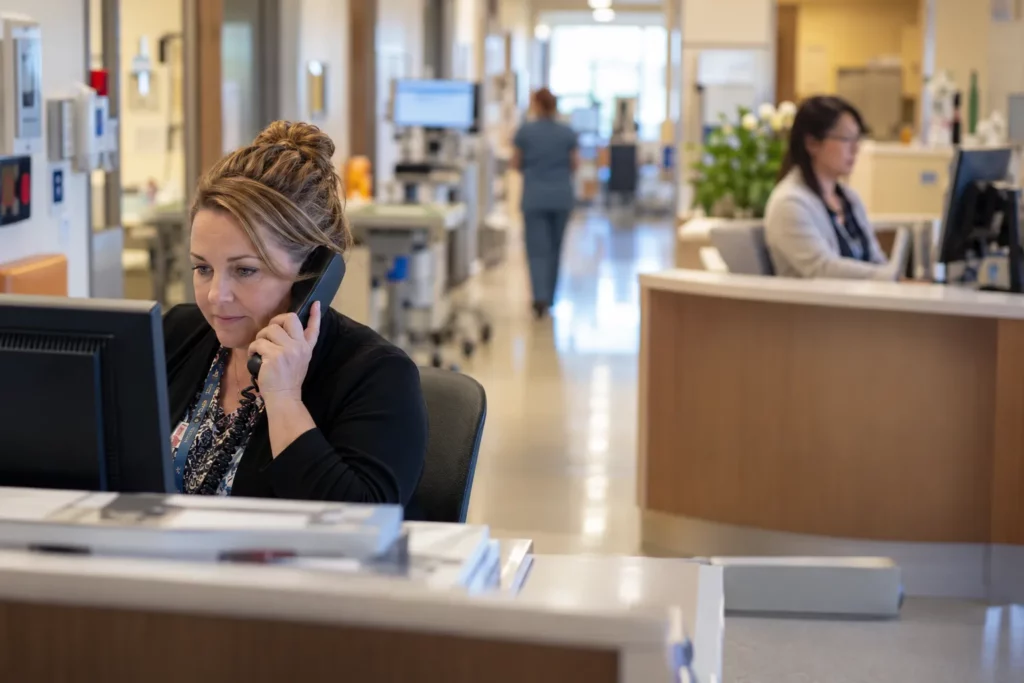
A Unit Clerk (sometimes called a ward clerk or health unit coordinator) works inside a hospital, on a specific nursing unit or ward. A unit clerk supports the clinical team rather than the patient directly — transcribing physician orders, maintaining patient charts, coordinating between departments, and keeping the nursing station organized.
Both roles are administrative rather than clinical — neither one provides hands-on patient care — but the setting, the pace, and the day-to-day tasks are quite different.

Where each role actually works
- Medical Office Assistant: family practice clinics, walk-in clinics, specialist offices (cardiology, physiotherapy, dermatology, etc.), dental offices, and community health clinics. Smaller teams, often just one or two MOAs per office.
- Unit Clerk: hospitals and larger health authority facilities, assigned to a specific unit — emergency, surgery, maternity, medicine, ICU. Works as part of a bigger care team including nurses, physicians, and other clerks.
What the job actually involves
A Medical Office Assistant’s day typically includes:
- Greeting patients and managing the front desk
- Scheduling and confirming appointments
- Verifying Alberta Health Care coverage and processing billing (including MSI/AHCIP billing codes in many clinics)
- Answering phones, managing referrals, and handling correspondence between the clinic and other providers
- Light bookkeeping, supply ordering, and general office administration
A Unit Clerk’s day typically includes:
- Transcribing and processing physician orders into the patient chart
- Maintaining and organizing patient charts for an entire unit
- Coordinating communication between nursing staff, physicians, lab, diagnostic imaging, and other hospital departments
- Admitting, transferring, and discharging patients on the unit from an administrative standpoint
- Answering the unit’s phones and call bells, and directing visitors
The practical difference: an MOA’s job is closer to running a small business’s front office, with a strong customer-service and billing component. A unit clerk’s job is closer to being the administrative hub of a hospital ward, with a strong focus on accuracy, medical terminology, and coordination under time pressure.
| Medical office assistant | Unit clerk | |
|---|---|---|
| Where | Family and walk-in clinics, specialist and dental offices, community health clinics | A specific hospital unit: emergency, surgery, maternity, medicine, ICU |
| Main work | Front desk, appointments, billing, referrals, correspondence | Physician orders, patient charts, coordination between departments, administrative admissions and discharges |
| Team | Often one or two administrative staff per office | A larger care team of nurses, physicians and other clerks |
| Hours | Many clinics keep regular daytime hours | Shifts that may include evenings, nights and weekends |
| Job Bank group | Medical administrative assistants (NOC 13112) | General office support workers (NOC 14100), a broader group |
| Alberta median wage | $29.00 an hour | $25.00 an hour (typical range $15.50 to $36.13) |
| Outlook 2025–2027 | Good | Limited |
Figures from Job Bank, as set out in the sections below. The unit-clerk figures come from a broad group of office jobs, so treat them as a general reference.
Training and how you get hired
According to Job Bank, Medical Administrative Assistants (NOC 13112, the Job Bank group that best matches the duties of a medical office assistant) usually need a college diploma, a short apprenticeship, or more than six months of on-the-job training. Employers generally look for formal training in medical terminology, scheduling and billing software, and Alberta Health Care billing procedures — which is exactly the kind of foundation a program like Ucademy’s Medical Office Assistant program is built around.
Unit Clerk positions, by contrast, fall under Job Bank’s broader “General Office Support Workers” category (NOC 14100), where the typical requirement is a secondary school diploma or several weeks of on-the-job training. In practice, postings for unit clerk roles may list a health unit coordinator or unit clerk certificate, because the role uses hospital-specific chart systems and medical terminology that aren’t picked up quickly on the job. Check current postings for the requirement. The lower “official” education bar doesn’t mean the job is easier — hospital-specific chart systems and medical terminology still have to be learned, and stand-alone unit clerk training is less standardized than medical office training. (Ucademy’s Medical Office Assistant & Unit Clerk Certificate includes a unit-clerk course; see below.)
What Job Bank says about pay and demand in Alberta
These are the most recent published figures from the Government of Canada Job Bank for each occupation in Alberta:
- Medical Administrative Assistant (NOC 13112): median wage of $29.00/hour. Job Bank rates the 2025–2027 employment outlook as Good, citing moderate growth in new positions, a moderate number of retirements opening up spots, and only a small number of recent job seekers competing for them. Job Bank also notes that Alberta’s Budget 2025 allocates $28 billion to health services, a 5.4% increase over the previous year — a relevant signal for clinic-based healthcare admin roles.
- Unit Clerk (NOC 14100): median wage of $25.00/hour, with a typical range of $15.50 to $36.13/hour. Job Bank rates the 2025–2027 outlook as Limited for this broader category, noting that employment is expected to stay relatively stable and that increased use of software and automation may mean fewer positions over time.
Two caveats worth being upfront about. First, the Unit Clerk figures come from Job Bank’s broader general office support category, not a role-specific code, so they include a wide range of office jobs beyond hospital unit clerks — treat them as a general reference point, not an exact match. Second, none of these numbers are a promise of what any individual will earn or how quickly they’ll be hired; wages and openings vary by employer, location, and experience.
Where the jobs sit: what Job Bank says about employers
The usual shorthand is “MOAs work in clinics, unit clerks work in hospitals”. Job Bank’s industry data for Alberta shows the picture is a bit more nuanced:
- Medical administrative assistants (the Job Bank group that covers medical office assistants): about 61% work in ambulatory health care services (clinics and similar community settings) and about 28% work in hospitals.
- General office support workers (the Job Bank group that includes unit clerks): about 23% work in hospitals, with the rest spread across other industries including construction (8%), ambulatory health care services (5%) and other retail stores (5%). Job Bank counts roughly 15,000 workers in this group across Alberta.
Two takeaways. First, an MOA credential is not limited to clinic work — a meaningful share of medical administrative roles are in hospitals. Second, because Job Bank’s unit-clerk figures cover a wide group of office jobs, only a portion of that group is hospital unit-clerk work specifically. Treat these numbers as a general guide rather than an exact count of unit-clerk openings.
Data: Government of Canada Job Bank, Alberta, 2025–2027 outlook, modified August 7, 2026 (13112, 14100).
Pay by Region and Benefits in Alberta
Where you work in Alberta changes the numbers. These are Job Bank median hourly wages by region (2023–2024 data); half of workers in each group earn more and half earn less.
| Region | Medical administrative assistants (MOA group, NOC 13112) | Unit clerks (NOC 14100) |
|---|---|---|
| Alberta overall | $29.00 | $25.00 |
| Calgary | $30.28 | $25.38 |
| Edmonton | $29.00 | $25.00 |
| Red Deer | $29.00 | — |
| Camrose–Drumheller | $27.13 | $26.00 |
| Lethbridge–Medicine Hat | $26.05 | — |
| Wood Buffalo–Cold Lake | $26.24 | — |
— = figure not shown here. Source: Government of Canada Job Bank, Alberta wages pages for 13112 and 14100.
Job Bank also reports how many workers receive at least one non-wage benefit, such as a pension plan, health or dental coverage, or leave entitlements: 63.9% of medical administrative assistants in Alberta and 75% of unit clerks. Benefits, hours and wages vary by employer, so compare the whole offer rather than the hourly rate alone. These figures are not a promise of what any individual will earn.
Medical office assistant vs unit clerk: more of the numbers
Official data about medical administrative assistants and unit clerks across Alberta, from Job Bank (Government of Canada) and the Alberta Wage and Salary Survey. It describes these jobs, not what Ucademy students will earn, and it includes the less favourable figures as well as the good ones.
| Alberta | Athabasca–Grande Prairie | Banff–Jasper | Calgary | Camrose–Drumheller | Edmonton | Lethbridge–Medicine Hat | Red Deer | Wood Buffalo–Cold Lake | |
|---|---|---|---|---|---|---|---|---|---|
| Medical administrative assistant (MOA group) NOC 13112 |
Good | Very good | Very good | Good | Very good | Good | Very good | Very good | Very good |
| Receptionist (Job Bank’s “Medical Office Assistant”) NOC 14101 |
Moderate | Moderate | Moderate | Moderate | Moderate | Moderate | Moderate | Moderate | Moderate |
| Unit clerk (general office support) NOC 14100 |
Limited | Limited | Limited | Limited | Limited | Limited | Limited | Limited | Very limited |
Job Bank rates the outlook for each region from Very limited to Very good, or Undetermined where it cannot rate it. Why Job Bank rates unit clerks Limited: Employment is expected to remain relatively stable. A moderate number of positions will become available due to retirements. There are a moderate number of unemployed workers with recent experience in this occupation. General office support workers are employed across all industries, though demand for this occupation is driven by hospital and public administration budgets. Key trends for this occupation include the use of advanced software and automation which may result in more complex tasks and fewer positions in the future.
Source: Job Bank, job prospects 2025–2027 · outlook updated Dec 10, 2025.
View the data as a table
| Area | Low | Median | High | Data |
|---|---|---|---|---|
| MOA group · Alberta | $20.00/hr | $29.00/hr | $35.00/hr | Labour Force Survey, 2023–2024 |
| MOA group · Calgary | $20.00/hr | $30.28/hr | $35.00/hr | Labour Force Survey, 2023–2024 |
| MOA group · Edmonton | $22.00/hr | $29.00/hr | $35.90/hr | Labour Force Survey, 2023–2024 |
| MOA group · Canada | $18.92/hr | $25.00/hr | $32.00/hr | Labour Force Survey, 2023–2024 |
| Unit clerks · Alberta | $15.50/hr | $25.00/hr | $36.13/hr | Labour Force Survey, 2023–2024 |
| Unit clerks · Calgary | $18.00/hr | $25.38/hr | $36.06/hr | Labour Force Survey, 2023–2024 |
| Unit clerks · Edmonton | $15.50/hr | $25.00/hr | $36.13/hr | Labour Force Survey, 2023–2024 |
| Unit clerks · Canada | $16.55/hr | $23.99/hr | $34.00/hr | Labour Force Survey, 2023–2024 |
Job Bank’s “low” and “high” are, in most cases, the 10th and 90th percentiles: about one worker in ten earns the low figure or less and about one in ten earns the high figure or more. Wages depend on the employer, experience and location and are not guaranteed. The unit clerk figures come from the broad general office support group, which includes many office jobs outside hospitals.
Source: Job Bank, wages by occupation (NOC 13112, 14100) · wages updated Nov 19, 2025; reference period 2023–2024, estimate rows 2024.
View the data as a table
| medical administrative assistants | general office support (unit clerks) | all occupations | |
|---|---|---|---|
| No high school diploma | <5% | 9% | 10% |
| High school diploma | 17% | 35% | 28% |
| Apprenticeship or trades certificate | 28% | 15% | 13% |
| College certificate or diploma | 38% | 23% | 19% |
| Bachelor’s degree | 10% | 14% | 21% |
| Above bachelor’s | <5% | <5% | 9% |
“College certificate or diploma” includes a university certificate below a bachelor’s degree.
Source: Job Bank, educational attainment of Alberta workers (NOC 13112, 14100) · Alberta, outlook pages updated Dec 10, 2025.
| Group | Start | Overall | Top | Reliability code |
|---|---|---|---|---|
| Medical administrative assistants (13112), all industries | $23.57 | $27.55 | $29.99 | B |
| Receptionists (14101), all industries | $19.06 | $21.94 | $26.24 | A |
| General office support (14100), all industries | $23.46 | $27.24 | $31.25 | A |
| General office support (14100), health care and social assistance only | $24.69 | $28.54 | $30.42 | B |
“Start” is the average pay employers offered for entry-level positions with the title, not what any program’s graduates earn. The medical administrative assistant survey figures have a Good (B) reliability code and show repeated values, so averages only are shown. The survey excludes overtime, bonuses and benefits and differs from Job Bank, so the numbers differ.
Source: Alberta Wage and Salary Survey 2023 (alis) · employer survey, 2023.
Data checked October 19, 2026: Job Bank wages updated Nov 19, 2025, outlooks Dec 10, 2025 (recent trends Jul 28, 2026); Alberta Wage and Salary Survey 2023. Occupation data, not a program outcome.
Pace, Hours and Team Size: What Daily Life Can Feel Like
Job titles aside, the two roles can feel different from day to day:
- Hours. Hospital units run around the clock, so unit-clerk roles commonly involve shifts that may include evenings, nights and weekends. Many clinics keep more regular daytime hours. Always check the schedule in the specific posting.
- Team size. A clinic may have one or two administrative staff, so you handle a wide mix of tasks. A hospital unit has a larger team with more defined responsibilities.
- Type of pressure. Front-desk work in a clinic is more about patient-facing service and billing; unit-clerk work is more about accuracy and coordination while many things happen at once.
- Shared skills. Medical terminology, electronic health record use, careful documentation, privacy and confidentiality, and clear communication matter in both roles, so training in one transfers well to the other.
None of this is a rule — employers differ. Reading three or four current postings for each role in your city is the fastest way to see what is typical near you.
Which role fits your working style
If you like the idea of patient-facing work, a consistent front-office routine, and being part of a small clinical team, the Medical Office Assistant path tends to be the better fit — and right now it’s the one with the clearer training pipeline and the stronger published outlook in Alberta. If you’re drawn to hospital environments, don’t mind working behind the scenes, and want to be the coordination point for a busy unit, Unit Clerk work can be a good match — though stand-alone unit clerk training can be harder to find elsewhere. Ucademy’s Medical Office Assistant & Unit Clerk Certificate covers the foundations of both roles (see below).
Either way, both roles are administrative entry points into the healthcare system that do not require years of clinical training.
A Five-Question Self-Check
- Do you prefer talking with patients all day, or supporting a clinical team behind the scenes? Front-desk-heavy → MOA; coordination-heavy → unit clerk.
- Are rotating shifts a deal-breaker? If yes, check whether the clinic roles near you offer daytime hours.
- Do you like billing and bookkeeping tasks? Billing is a larger part of many MOA jobs.
- Do you want a small team or a large one?
- How important is the Job Bank outlook to you? Job Bank rates medical administrative assistants as Good and the broader unit-clerk group as Limited for 2025–2027 in Alberta — but the unit-clerk figure covers a wide range of office jobs, so use it as a general reference.
Still undecided? Try the one-minute program quiz or read How to Become a Medical Office Assistant in Alberta and How to Become a Unit Clerk in Alberta.

One program that covers both roles
You do not necessarily have to choose between the two paths before you start training. Ucademy’s Medical Office Assistant & Unit Clerk Certificate is designed to cover the foundations of both roles in a single 516-hour program of 12 courses. It includes medical terminology, electronic health records with the SimChart EHR, medical billing and coding (ICD-10-CA / CCI), medical office procedures and privacy regulations, a course on the fundamentals of unit clerk operations, and a supervised practicum of about 100 hours.
The program is delivered online and is self-paced; as a guide, part-time study of 12–15 hours a week takes roughly nine months. Request Information for program details.
Next step
If the Medical Office Assistant path sounds like the right fit, take a look at the Medical Office Assistant program page for what the training covers, or browse the full list of Ucademy programs to compare options. Have questions about how the program works? Check the FAQ or request information.
Sources
- Job Bank: job prospects, medical administrative assistants in Alberta (NOC 13112)
- Job Bank: wages, medical administrative assistants in Alberta
- Job Bank: job prospects, general office support workers in Alberta (NOC 14100)
- Job Bank: wages, general office support workers in Alberta
- alis: wages and salaries in Alberta, medical administrative assistants (NOC 13112)
Wage and outlook figures are labour-market estimates for guidance only and are not a promise of earnings or hiring.
Frequently Asked Questions
Which has the better job outlook in Alberta, a medical office assistant or a unit clerk?
For 2025–2027, Government of Canada Job Bank (jobbank.gc.ca) rates the outlook for medical administrative assistants (the group covering medical office assistants) as Good in Alberta and for general office support workers (the group that includes unit clerks) as Limited. The unit-clerk group is broad, so its rating is a general indicator rather than a measure of hospital unit-clerk jobs alone. Outlook ratings are not a guarantee of work for any individual.
Do medical office assistants only work in clinics?
No. Job Bank's Alberta data shows most medical administrative assistants work in ambulatory health care services such as clinics (about 61%), and a meaningful share (about 28%) work in hospitals.
Can I train for both roles at once?
Some programs cover both. Ucademy's Medical Office Assistant & Unit Clerk Certificate (516 hours) includes both medical-office and unit-clerk content, plus a supervised practicum. Employers set their own hiring requirements, so training does not guarantee a particular job.
How much do medical office assistants and unit clerks make in Alberta?
Government of Canada Job Bank (jobbank.gc.ca) gives an Alberta median wage of $29.00 an hour for medical administrative assistants and $25.00 an hour for unit clerks (general office support workers), with regional differences — for example, the Calgary and Lethbridge–Medicine Hat medians for medical administrative assistants are $30.28 and $26.05. These are occupation-level medians, not a guarantee of any individual's pay.