

What healthcare administration covers
Healthcare administration is the business side of patient care. It covers every function that keeps a medical facility running efficiently — scheduling appointments, maintaining patient records, handling billing and insurance forms, coordinating communications between departments, and supporting clinical staff with documentation. Healthcare administrators do not provide direct clinical care; they make it possible for the people who do.
If you are interested in the healthcare sector but not drawn to clinical or hands-on roles, healthcare administration is a clear career path. Alberta has a large healthcare system, and Job Bank rates the 2025–2027 Alberta outlook as Good for medical administrative assistants but Limited for general office support work such as unit clerks.
- The work: scheduling, patient records, billing and insurance forms, and communication between departments. Healthcare administrators do not provide clinical care.
- Four common roles: medical office assistant, medical receptionist, unit clerk and health records clerk.
- Outlook in Alberta, 2025–2027 (Job Bank): Good for medical administrative assistants, Limited for general office support work such as unit clerks.
- Pay: the Alberta median for medical administrative assistants is $29.00 an hour, and about 9,150 people work in the occupation.
- Skills employers look for: medical terminology, EMR software, scheduling, calm communication and respect for patient privacy.

Key Roles in Healthcare Administration
Medical Office Assistant
Medical office assistants handle the day-to-day operations of a medical clinic or doctor’s office. Responsibilities typically include booking and confirming appointments, greeting patients, updating electronic medical records (EMR), processing referrals, and managing incoming correspondence. This is often the first role people enter when moving into healthcare administration. Our comparison of medical office assistants and unit clerks shows how the two jobs differ.
Medical Receptionist
Similar to a medical office assistant, a medical receptionist is the first point of contact for patients. The role is heavily focused on communication — phone, email, and in-person — and requires a calm, professional manner and strong organizational skills.
Unit Clerk
Unit clerks work in hospital settings, supporting a specific ward or department. They coordinate patient admissions and discharges, prepare charts, liaise between nursing staff and other departments, and manage the administrative flow on a busy unit. We explain the path in how to become a unit clerk in Alberta.
Health Records Clerk
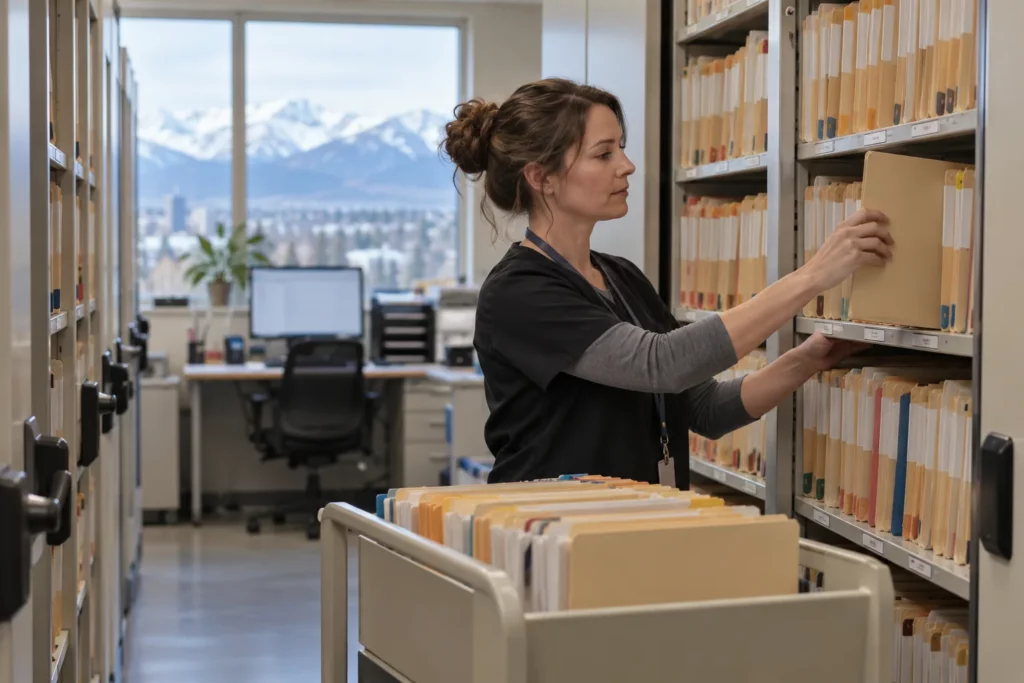
Health records clerks are responsible for organizing, maintaining, and retrieving patient records. Accuracy is critical in this role — errors in health records can have serious consequences for patient care. As facilities move to electronic systems, this role increasingly requires comfort with EMR software and data management.
| Role | Where it works | Main work | What matters most |
|---|---|---|---|
| Medical office assistant | Medical clinics and doctors’ offices | Booking and confirming appointments, greeting patients, updating EMR, processing referrals, correspondence | Organization and a calm manner with patients |
| Medical receptionist | Clinics, as the first point of contact | Phone, email and in-person communication | Professional communication |
| Unit clerk | A ward or department in a hospital | Admissions and discharges, preparing charts, liaising between nursing staff and other departments | Coordination on a busy unit |
| Health records clerk | Facilities that keep patient records | Organizing, maintaining and retrieving records | Accuracy and comfort with EMR software |
Summary of the role descriptions above. Job Bank files these jobs under different occupation groups, which the data section below sets out.
Where Healthcare Administrators Work in Alberta
Healthcare administration roles exist across a wide range of settings:
- Family medicine and specialist clinics
- Hospitals and regional health authorities (including Alberta Health Services)
- Long-term care and continuing care facilities
- Dental and optometry offices
- Physiotherapy and rehabilitation centres
- Community health and mental health organizations
Alberta Health Services is one of the largest health authorities in Canada and employs administrative staff at many sites across the province. Rural and urban communities alike need front-office healthcare staff.
Skills That Healthcare Administrators Need
Succeeding in a healthcare administration role requires a specific combination of technical knowledge and interpersonal skill.
Medical Terminology
You do not need to diagnose conditions, but you do need to understand the language of medicine well enough to accurately transcribe information, process referrals, and communicate with clinical staff. Errors in medical terminology can create significant problems in patient care.
Electronic Medical Records (EMR) Software
Most Alberta clinics and facilities use EMR systems such as OSCAR, Accuro, or Wolf to manage patient information. Training on these systems, or closely related software, is a practical advantage when applying. Our explainer on EMR systems in Alberta clinics covers what they do.
Scheduling and Coordination
Managing appointment books, coordinating across multiple providers, and handling cancellations and urgent bookings requires careful attention to detail and the ability to adapt quickly when priorities change.
Communication and Patient Interaction
Healthcare settings attract people who are stressed, unwell, or anxious. A calm, empathetic communication style is part of the job. Written communication skills matter equally for correspondence with other providers, insurers, and referral offices.
Confidentiality and Compliance
Patient information is protected under Alberta’s Health Information Act. Every healthcare administrator must understand their obligations around confidentiality and privacy, and apply those standards consistently.
What affects healthcare administration jobs in Alberta
Alberta’s population is growing and aging. As the proportion of older adults increases, so does the use of healthcare services across the continuum — from primary care to specialist clinics to long-term care. This adds demand for administrative support in every part of the system.
Demand is not equal across roles. Job Bank rates medical administrative assistants Good and general office support work, which includes unit clerks, Limited, so check the exact title you are aiming for. For current wage information in your area, visit the Job Bank (Government of Canada) and search by occupation and Alberta region.
Healthcare administration jobs in Alberta: the numbers
Official data about healthcare administration occupations across Alberta, from Job Bank (Government of Canada) and the Alberta Wage and Salary Survey. It describes these jobs, not what Ucademy students will earn, and it includes the less favourable figures as well as the good ones.
Source: Job Bank (NOC 13112, 14100) · wages updated Nov 19, 2025; outlook updated Dec 10, 2025.
| Role | Job Bank group | Alberta median (low–high) | Outlook 2025–2027 | Employed in Alberta | Usual requirements |
|---|---|---|---|---|---|
| Medical office assistant / medical administrative assistant | Medical administrative assistants (13112) | $29.00 ($20.00–$35.00) | Good | ~9,150 | Secondary school, plus a 1–2 year college program or other specialized courses for secretaries or medical secretaries |
| Medical receptionist | Receptionists (14101) | $21.00 ($16.75–$30.00) | Moderate | ~20,400 | Secondary school; on-the-job training may be provided |
| Unit clerk and health records clerk | General office support workers (14100) | $25.00 ($15.50–$36.13) | Limited | ~15,000 | Secondary school, or college business or commercial courses |
| Health information management technician (records work that needs a college diploma) | Health information management occupations (12111) | $36.73* ($27.51–$46.83) | Good | not published | Two-year college diploma in health record technology or health information management; employers may require the CHIMA national certification exam |
* 2024 Statistics Canada model estimate. Unit clerks and health records clerks are both filed under general office support workers, a broad group where only about a quarter work in hospitals. Job Bank does not publish a head count for health information management occupations.
Source: Job Bank, wages, outlooks and requirements (NOC 13112, 14101, 14100, 12111) · wages updated Nov 19, 2025; outlook updated Dec 10, 2025.
| Alberta | Athabasca–Grande Prairie | Banff–Jasper | Calgary | Camrose–Drumheller | Edmonton | Lethbridge–Medicine Hat | Red Deer | Wood Buffalo–Cold Lake | |
|---|---|---|---|---|---|---|---|---|---|
| Medical administrative assistant NOC 13112 |
Good | Very good | Very good | Good | Very good | Good | Very good | Very good | Very good |
| Medical receptionist NOC 14101 |
Moderate | Moderate | Moderate | Moderate | Moderate | Moderate | Moderate | Moderate | Moderate |
| Unit clerk / health records clerk NOC 14100 |
Limited | Limited | Limited | Limited | Limited | Limited | Limited | Limited | Very limited |
| Health information management NOC 12111 |
Good | Good | Good | Good | Undetermined | Good | Undetermined | Undetermined | Undetermined |
Job Bank rates the outlook for each region from Very limited to Very good, or Undetermined where it cannot rate it. Unit clerk work is rated Limited in Alberta, so the picture is not uniformly strong across healthcare administration.
Source: Job Bank, job prospects 2025–2027 · outlook updated Dec 10, 2025.
- Ambulatory health care services 61%
- Hospitals 28%
- All other sectors 11%
Job Bank lists only the largest industries; the rest are spread across many others.
Source: Job Bank, workers by industry (NOC 13112) · Alberta, outlook updated Dec 10, 2025.
View the data as a table
| Area | Low | Median | High | Data |
|---|---|---|---|---|
| Med. admin asst. (13112) | $20.00/hr | $29.00/hr | $35.00/hr | Labour Force Survey, 2023–2024 |
| Receptionists (14101) | $16.75/hr | $21.00/hr | $30.00/hr | Labour Force Survey, 2023–2024 |
| Gen. office support | $15.50/hr | $25.00/hr | $36.13/hr | Labour Force Survey, 2023–2024 |
| Health info mgmt (12111) | $27.51/hr | $36.73/hr | $46.83/hr | Statistics Canada model estimate, 2024 |
Job Bank’s “low” and “high” are, in most cases, the 10th and 90th percentiles: about one worker in ten earns the low figure or less and about one in ten earns the high figure or more. Wages depend on the employer, experience and location and are not guaranteed. Rows marked * are Statistics Canada model estimates for 2024 (Job Bank, Small Area Estimation) rather than survey results, so compare them with care.
Source: Job Bank, wages by occupation (NOC 13112, 14101, 14100, 12111) · wages updated Nov 19, 2025; reference period 2023–2024, estimate rows 2024.
Data checked October 19, 2026: Job Bank wages updated Nov 19, 2025, outlooks Dec 10, 2025 (recent trends Jul 28, 2026); Alberta Wage and Salary Survey 2023. Occupation data, not a program outcome.
How to Get Qualified
A focused certificate or diploma program is a common route into healthcare administration in Alberta. The Medical Office Assistant program at Ucademy (516 hours) covers medical terminology, scheduling, EMR basics, billing documentation, and professional communication — the core competencies that employers in Alberta clinics and facilities look for.
Training is delivered online, so you can complete the program from anywhere in Alberta without relocating. It is designed for adults moving into healthcare from another industry or starting a first career.
Where to go next
If organized office work in a healthcare setting appeals to you, Job Bank’s outlook ratings show which roles have the strongest prospects in Alberta. Visit the Medical Office Assistant program page for full program details, and explore the Ucademy career resources page to support your planning.
Sources
- Job Bank: job prospects, medical administrative assistants in Alberta (NOC 13112)
- Job Bank: wages, medical administrative assistants in Alberta
- Job Bank: job prospects, general office support workers in Alberta (NOC 14100)
- Job Bank: wages, general office support workers in Alberta
- alis: wages and salaries in Alberta, medical administrative assistants (NOC 13112)
Wage and outlook figures are labour-market estimates for guidance only and are not a promise of earnings or hiring.
Frequently Asked Questions
What does a healthcare administrator actually do day-to-day?
Healthcare administrators handle the operational and clerical backbone of medical environments — scheduling patients, managing health records, coordinating between clinical staff, processing billing and insurance information, and ensuring the office runs efficiently so clinicians can focus on patient care.
Do I need a clinical background to work in healthcare administration?
No clinical background is required for most administrative roles. Programs in healthcare administration or medical office support teach you the medical terminology, records systems, and office procedures you need without requiring nursing or clinical training.
What settings can I work in with a healthcare administration credential in Alberta?
Graduates work in hospitals, family medicine clinics, dental and specialist offices, long-term care facilities, rehabilitation centres, and provincial health authority offices across Alberta. The range of workplaces is broad, which provides flexibility in where you build your career.
What skills are most important for success in healthcare administration?
Attention to detail, discretion with confidential patient information, strong organizational skills, and clear written and verbal communication are consistently valued. Familiarity with electronic medical record software is also increasingly expected by Alberta employers.